Inventory Management
Procurement
Method Pay
Analytics & Reporting

The dental practice down the street just switched suppliers to save 5% on gloves. Three months later, they're spending more than ever. How does that happen? They confused low prices with low costs.
This happens constantly in dental procurement. Practices chase unit prices while hemorrhaging money elsewhere. The math seems simple: lower price per box equals lower spending. But procurement doesn't work that way.
Real savings come from how you buy, not just what you pay.

"Partnership" gets thrown around constantly in dental sales. Usually, it means nothing. But when a supply relationship actually functions as a partnership, you see specific outcomes.
Not just invoices. Real visibility into where money goes across all vendors, all locations, all product categories. You spot patterns. You identify opportunities. You make decisions based on data instead of hunches.
Good partners create competition among suppliers on your behalf. They run RFPs. They negotiate terms. They manage vendor relationships so you don't have to chase down quotes or compare proposals manually.
Your supply partner should help you build and maintain a formulary that balances clinical quality with cost. That means proactive recommendations when equivalent products are available at better pricing, not pushing their own inventory.
Consistent fulfillment windows let your team plan around arrivals instead of scrambling when orders show up late or incomplete. Look for partners who provide real-time order tracking and proactive communication when delays happen, not ones who make you chase down every shipment.
Lead times should be predictable and transparent. The best partners set clear expectations on when orders will arrive and flag exceptions before they become problems. Practices that lose chair time waiting on supplies are losing production revenue, and that cost rarely shows up on a price comparison spreadsheet.
Partial shipments and backorders create hidden costs: reordering, follow-up calls, clinical workarounds, missed procedures. Track your suppliers' fill rates over time. A partner consistently hitting 95%+ fulfillment is worth more than one quoting 10% lower prices but shipping 80% of what you ordered.
When you're assessing potential supply companies, certain signals matter more than others.
Opacity in pricing
If a supplier can't show you comparative data or provide clear visibility into your spending, they benefit from your lack of information. Competitive processes should reduce costs. Suppliers avoiding competition keep prices high.
Policies that work for them not you
Restocking fees, minimum order requirements, forced auto-ship programs, and restrictive return windows all shift risk from the supplier to your practice. If the terms of the relationship consistently protect the vendor at your expense, the pricing advantage will disappear in the fine print.
Manual workflows
Time-consuming procurement processes cost money. Partners worth having provide automation that reclaims your team's time.
Limited options
Forced exclusivity or restricted vendor access means you can't create competitive dynamics. Real partners expand your options instead of limiting them.
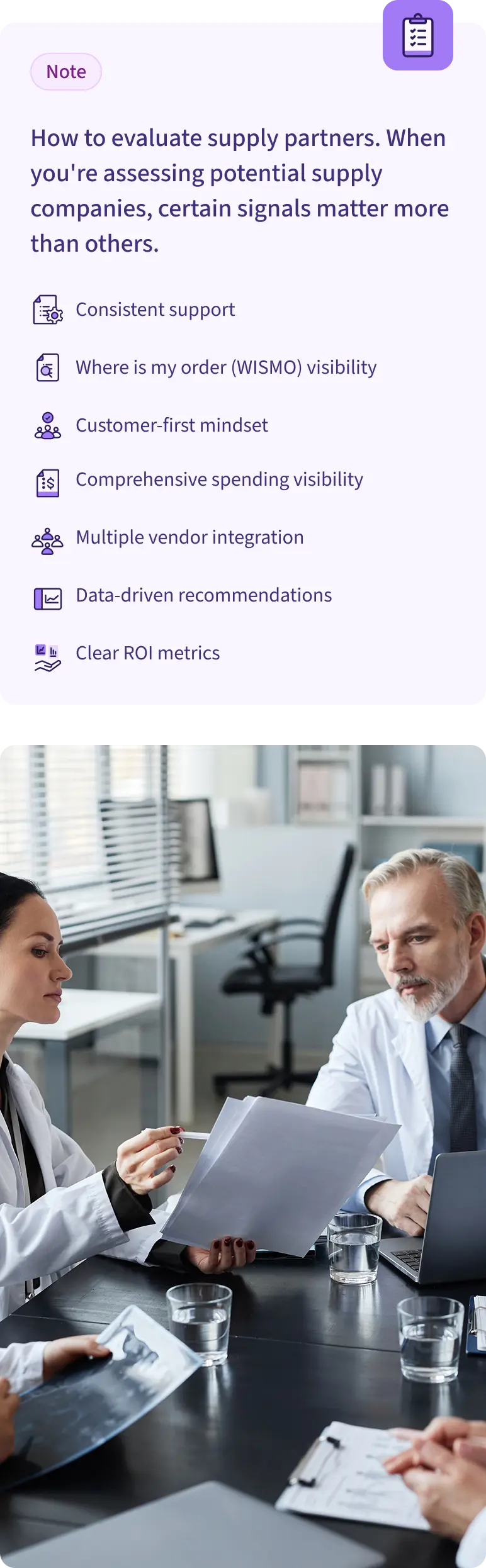
Consistent support
When an order goes wrong or a product question comes up, how quickly does your supply partner respond? Practices operate on tight schedules. A supplier that takes 48 hours to answer a fulfillment question costs you more than just the delayed product.
Where is my order (WISMO) visibility
You should be able to track every order from placement through delivery without picking up the phone. Real-time status updates, shipping confirmations, and delivery tracking should be standard.
Customer-first mindset
You can tell a great supply company by how they handle when things go wrong. Partners who absorb friction on your behalf, handling returns, chasing down missing items, correcting invoice errors, demonstrate that their business model depends on your success, not just your spend.
Comprehensive spending visibility
You should see exactly where money goes, with the granularity to identify specific opportunities. The best partners run procurement processes that can deliver better pricing without consuming your time.
Multiple vendor integration
Choice creates leverage. Partners who integrate with other suppliers let you maintain competitive pressure.
Data-driven recommendations
Your partner should proactively identify cost reduction opportunities based on your actual spending patterns.
Clear ROI metrics
If a partner can't demonstrate specific, measurable outcomes, they probably aren't delivering them.
Implementation looks different depending on your role and practice size. But the fundamentals remain consistent.
The compound effect matters here. Small process improvements stack. A 2% reduction this quarter, another 3% next quarter, ongoing optimization over time. Systematic approaches to procurement create advantages that grow.
Strategic partnerships deliver better pricing. Full stop.
When you work with supply companies that provide transparency, create competition, and optimize your supply chain, you reduce costs more effectively than chasing unit prices ever could.
The practices spending less on supplies are the ones with organized procurement.
Every month you delay implementing strategic procurement, you leave money on the table. Money that compounds over time. Money your practice generated through production but lost through disorganized purchasing.
Talk to the Method team today to learn how we can support stronger relationships with your dental supply vendors.