Inventory Management
Procurement
Method Pay
Analytics & Reporting

Nobody wants to reach for a crucial supply only to find an empty shelf or an expired box. Yet inventory management is one of the most common sources of friction in dental practices, and it has a direct impact on your bottom line.
Dental practices can tie up as much as 30% of their annual revenue in inventory. Every dollar of wasted supply requires roughly four dollars in production revenue to recover. That makes poor inventory management one of the most expensive problems your practice can have, even if you never notice it happening.
Here's where most practices go wrong, and how to fix it.
Inventory management is more than busy work. It sits at the center of how efficiently your practice runs, how much you spend, and how productive your team is every day.
When your supply process works, your team spends less time hunting for products, placing emergency orders, or dealing with stockouts. That time goes back into patient care. When it doesn't work, the costs compound quickly: tied-up capital, rush shipping fees, treatment delays, and frustrated staff.
On the patient-facing side, rescheduling a procedure because you're missing a critical item erodes trust. Patient reviews can shape a practice's reputation, and these "small" hiccups add up. Getting supply management right protects both your margins and your patient experience.
One of the biggest inventory blunders is relying on gut feeling instead of data. Many practices don't look at their own usage history, which leads to either overstocking (tying up capital) or understocking (causing emergency orders).
The fix is straightforward: use your own production data. Using the data within your platform, analyze historical usage patterns, seasonal trends, and upcoming appointment volume to forecast what you actually need. The result is ordering the right amount at the right time, without unnecessary excess sitting on the shelf.
If you're only checking inventory when something runs out, you're already behind. Infrequent checks lead to expired products taking up shelf space and surprise stockouts during procedures.
Set a weekly or bi-weekly schedule for a full inventory review. Consistent monitoring gives you an accurate picture of your supplies and catches problems before they turn into patient-facing issues. Prevention is always cheaper than the alternative.
If you're managing inventory with spreadsheets or pen and paper, it's long past time for an upgrade. Manual systems are time-consuming and prone to errors. They also make it nearly impossible to get real-time visibility into what you have, what you need, and what you're spending.
Digital inventory management systems automate tracking, generate purchase orders, and alerts. The time savings alone can justify the switch, but the error reduction is where the real value shows up.
Going for the lowest price on every item feels like smart purchasing, but it misses the bigger picture. The difference between running at 4% of revenue on supplies versus 6% isn't about negotiating every supplier down by a few cents. It's about buying the right products at the right prices.
That means considering lead times, minimum order quantities, and supplier reliability alongside price. It also means factoring in your doctors' clinical preferences. A bargain composite that doesn't meet your dentist's standards for handling or aesthetics isn't a bargain. A slightly higher price from a vendor with faster shipping, better customer service, and consistent quality can save you money long-term by reducing rush orders and ensuring your clinical team has what they need.
A disorganized stockroom wastes time, hides expired products, and makes it harder for your team to find what they need. If pulling one box risks toppling a shelf's worth of supplies, your storage system needs work.
Use clear, labeled bins for smaller items. Arrange products by category or frequency of use. Follow a FIFO (First In, First Out) approach so older stock gets used before it expires. A well-organized supply room is one of the simplest changes a practice can make, and it pays off immediately.
Ordering in bulk "just in case" is a common instinct, especially for specialized items like specific composite shades or rarely used instruments. But it ties up capital and fills shelf space with products that may expire before they're ever used.
Instead, set appropriate par levels for each item based on actual usage data. For infrequently used items, work with suppliers who offer quick shipping on smaller orders. This keeps your inventory lean without sacrificing the ability to handle unexpected needs.
The best inventory system in the world fails if your team doesn't know how to use it. Inconsistent data entry, missed reorder points, and improper storage all stem from training gaps.
Make sure everyone on your team understands the importance of accurate data entry, proper storage procedures, and how to use your inventory management software. Regular refresher sessions reinforce best practices and keep everyone aligned as processes change.
Storing supplies across multiple locations throughout your practice leads to confusion, duplicate orders, and lost items. Centralize your inventory as much as possible by designating a primary stockroom.
If you need to keep certain items in treatment rooms for immediate access, treat those as mini-stockrooms with their own par levels and a regular restocking schedule. A centralized approach gives you a much clearer picture of what you actually have on hand.
If you're not regularly reviewing reports on your inventory levels, spending by category, and supplier performance, you're leaving money on the table.
We recommend that practices focus on three things to capture the majority of available savings: get organized, identify the right products for your practice (not necessarily the cheapest, but the most cost-effective for your clinical needs), and maintain a competitive purchasing process with multiple suppliers. Your data is what tells you whether you're actually doing those three things, or just thinking you are.
When inventory is everyone's job, it's no one's priority. Shared responsibility leads to inconsistencies, missed reorders, and a general lack of accountability.
Designate a primary inventory manager. In smaller practices, this might be the office manager or lead dental assistant. Larger practices or DSOs might have a dedicated inventory coordinator. This person doesn't need to do everything inventory-related, but they need to own the process and be the go-to for questions and decisions.
Jumping straight to a large order of a new product is a gamble. If it doesn't meet your clinical team's standards or your patients' expectations, you've wasted money and shelf space.
Start small. Many suppliers offer sample sizes or trial periods. Take advantage of these to test new items in your practice before committing to a full order. This is especially important for clinical supplies, where doctor preference and patient outcomes matter far more than a catalog description.
Failing to track expiration dates leads to waste and potential patient safety issues. It's especially common with less frequently used items that sit on the shelf longer than expected.
Remember our $1-to-$4 ratio: a $100 bottle of bonding agent that expires on the shelf requires $400 in production revenue to cover that loss. Implement a system for tracking expiration dates, whether that's through your digital inventory system's alert features or a color-coded approach in your stockroom that visually flags products nearing their expiration.
Effective inventory management drives efficiency, protects your margins, and supports better patient care. And the practices that get it right share a common approach: they build a system, document the process, set clear expectations, and follow through.
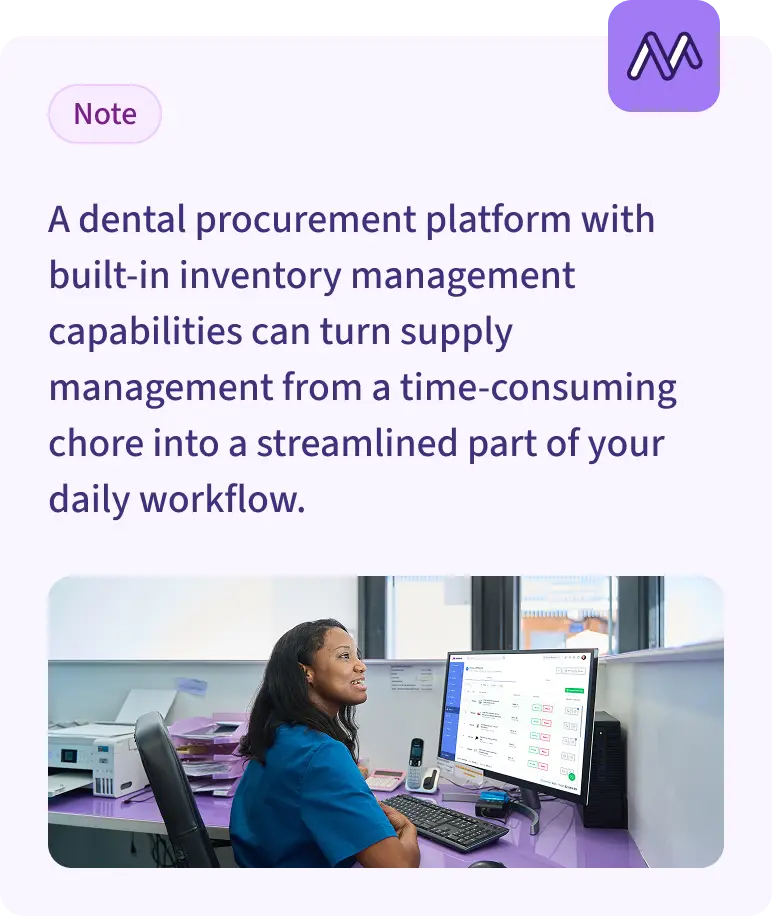
A dental procurement platform with built-in inventory management capabilities can turn supply management from a time-consuming chore into a streamlined part of your daily workflow.
Method is built specifically for this. From barcode scanning and formulary management to supplier price comparison and real-time inventory visibility, the platform helps practices reduce waste, order smarter, and free up time for patient care.