Inventory Management
Procurement
Method Pay
Analytics & Reporting

Procurement is a lot more than simply ordering supplies. In reality, it's a strategic process that involves optimizing four critical elements of ordering simultaneously.
You must ensure that you are ordering the right things, at the right time, from the right place, and at the right price.
This means optimizing your orders for the correct quality, timing, brands, and maintaining cost efficiency.
Mastering all four pillars of procurement can reduce equipment costs by 15-20%. True procurement success does not optimize solely on cost. Rather, balancing quality, timing, sourcing, and cost is vital. We’ll show you how.

Choosing the right products is a finely-tuned process that requires a few considerations.
Compromising on the quality of some products may be more detrimental to the operation of your practice than others especially when considering clinical items. These problems can become exponentially worse with numerous locations, so standardization is key.
When balancing quality and cost considerations, you must look at the function of each product. For example, patient-facing products should never be compromised for cost, whereas administrative items can be cost-optimized.
Have regular evaluation periods for new products and transition plans to phase out discontinued items. It is also worth your while to integrate digital catalogs that restrict purchases to only approved products.
Maintaining consistency across numerous locations is key to keeping costs low. A lack of uniformity increases cost and complexity. Standardized training and product use enable:
A higher-end composite may offer fractionally better aesthetics, but a mid-tier product may offer 90% of the benefit at half the cost. All of these considerations are important in determining which products to purchase for your practices.
The second pillar of procurement success is becoming a specialist at timing your inventory orders. Over-ordering ties up capital while under-ordering disrupts care.
Let’s look at how you can master inventory timing.
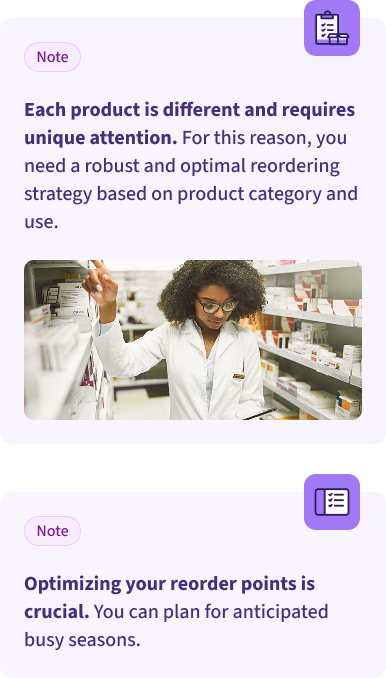
Optimizing your reorder points is crucial. You can plan for anticipated busy seasons, for example, the weeks before school starts and holiday breaks.
Each product is different and requires unique attention. For this reason, you need a robust and optimal reordering strategy based on product category and use.
Procurement tools can optimize your reorder points. With these tools, you can set automated reorder trigger points and tailor them for your exact needs.
One of the more disastrous scenarios in inventory planning is running out of an essential item. Imagine a scenario in which you run out of toothpaste, an essential client-facing item.
When planning when to order, you must ask yourself:
You must also consider expiration dates. Letting products go to waste is literally a waste of money. To avoid this, you should:
Remember, every $100 in expired supplies is $300-$400 lost in potential production.
Planning for the “when” in inventory forces you to look both into the past and to the future. Understanding historical usage can help you plan for the now, while looking ahead to expanding services can help you plan for the near future.
Staying up to date with the trends in dentistry and orthodontics is key to staying ahead of the curve. You must understand what will change in usage and be prepared for its effects on your practice.
Integrating tools into your operation is beneficial. Look to add features such as:
The correct procurement technology partner can bring your practice to the next level by ensuring you work with accurate and current data.
Choosing the right vendors is vital; you want a partnership built on respect, compliance, and reliability.
You should always have both primary and secondary suppliers. Primary relationships build stability, while secondary vendors are for backup or emergency scenarios.
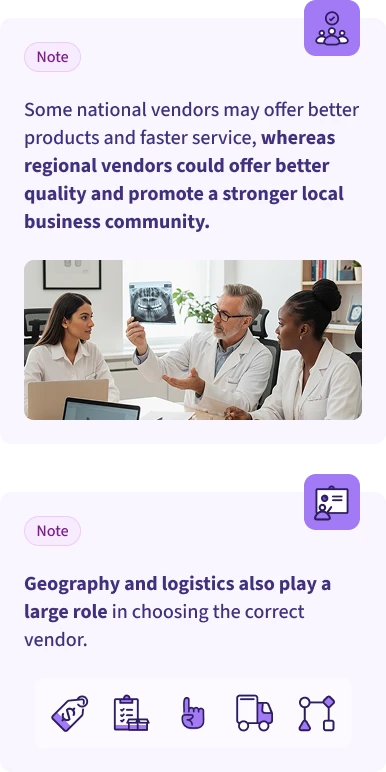
You must also compare national and regional distributors. Some national vendors may offer better products and faster service, whereas regional vendors could offer better quality and promote a stronger local business community.
Geographic and logistical factors
Geography and logistics also play a large role in choosing the correct vendor. You must optimize shipping based on:
Technological integration with your current operation is also a must when choosing a distributor. Your vendor should offer:
Building partnerships with vendors is important, but you may opt for short-term contracts to keep up with changing prices. Either way, you can mold relationships to your advantage with the correct approach. Look to negotiate points such as:
Regardless of the vendor(s) you choose, it’s always important to have contingency plans in a worst-case scenario. To properly manage any unforeseen turbulence, you should consider:
Perhaps a bit obvious, ensuring you don’t overpay for products is key to procurement. Price matters, but total cost matters more.
The sticker price you see is not the price you pay. Keep in mind that there are other associated costs unrelated to the per-unit price. These include:
Be aware of some negotiation tactics when dealing with distributors. You may find discounts that you didn’t know existed had you not employed tactics, including:
To excel at procurement, you must identify hidden costs.
Ensure you discuss rushed order premiums, understand that using numerous distributors can incur logistical costs, and invoice processing times may limit cash on hand.
Try to optimize payment terms through negotiation and limit the overall number of vendors you choose to work with.
Integrating procurement software can help keep costs low. You should consider using platforms that have:
Another vital facet of analyzing procurement cost is assessing current practices. You need to pay close attention to cost per procedure, yearly spending, and where you stand among competitors.
Understanding where you fit with these calculations will allow you to make better decisions on where to reduce costs and improve.
Try to reduce costs by employing strategic purchasing approaches. Bundling equipment, consolidating volume, negotiating timing with vendors, or developing private label programs can all help reduce your costs.
Mastering procurement is mastering all four pillars.
You may ask: Why must I pay attention to all four?
Mistakes truly can cause a domino effect in procurement. Incorrect timing creates waste, incorrect vendors can increase overhead, and wrong products can compromise your care. Any one mistake during the procurement process creates inefficiencies that cost you time and money.
Luckily, there are options to manage this strategy for you. Platforms that manage these four elements can save you valuable time and money.
The right software can manage your data, enforce and streamline workflows, and provide analytics to reveal optimization opportunities.
Tools that you should integrate into your practice should offer features such as:
Ensure you avoid common procurement mistakes. Focusing too intently on one part of the process can give false assurance of optimization. Look at the process holistically to ensure the best results. It’s always a plus to reduce human error and automate when you can; some manual processes, while seemingly straightforward, can break down.
So how can you implement an effective procurement strategy?
You first need to identify the current state of your procurement strategy across the four pillars. Analyze your spending, categorize your products, and audit every square inch of your process.
Cut out the fat and begin planning integration with platforms that can streamline your process. The first and most important step is identifying inefficiencies and understanding where you can improve.
Before a full-fledged adoption of a new strategy or tool. It’s best to start with high-impact opportunities to both create a foundation and to see immediate results. Expand gradually as your team adapts.

Procurement is a strategic business function that requires acute attention to four distinct elements.
It’s only with care given to all four pillars that you can optimize your procurement and take your practice to the next level.
By integrating with tools like Method, you can:
Ready to experience procurement that optimizes all four elements simultaneously? Schedule some time with one of our experts to see how leading practices are transforming supply chain management.