Inventory Management
Procurement
Method Pay
Analytics & Reporting

When a practice joins a group purchasing organization (GPO), oftentimes there’s an expectation of immediate savings.
Sign the contract, receive member materials, and wait for the cost reductions to appear on their statements.
This will only lead to disappointment six months down the line. The promised 15-20% savings never materialized. In fact, your spend probably looks identical to pre-GPO levels. The only difference is they're now paying membership fees.
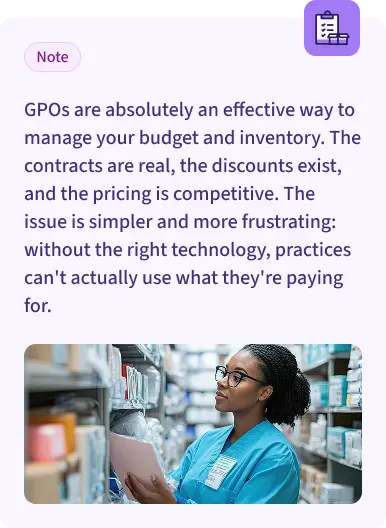
GPOs are absolutely an effective way to manage your budget and inventory. The contracts are real, the discounts exist, and the pricing is competitive. The issue is simpler and more frustrating: without the right technology, practices can't actually use what they're paying for.
Your GPO negotiates excellent contracts with major manufacturers. You receive a contract book or spreadsheet listing hundreds of products and their member pricing. Then reality sets in.
Your team needs yellow mixing tips. They've always ordered from 3M through their usual distributor. The tips cost $60 for a box of 48. Your GPO contract includes an identical tip from a private label manufacturer for $25. That's a 58% savings sitting unused in a contract book.
Why doesn't your team order the cheaper option?
They don't know it exists. They can't easily compare the specifications. They'd need to research multiple supplier websites to find it. And even if they locate it once, they won't remember six weeks later when they reorder.
Multiply this scenario across thousands of products, multiple locations, and different staff members. The GPO discount becomes theoretical rather than actual.

Working with the right inventory management and procurement platform turns static contract books into a live purchasing environment. Instead of expecting staff to research alternatives on their own, the platform can put contracted pricing and products directly into their ordering workflow.
When your dental assistant searches for mixing tips, the system shows your $25 contracted option right alongside the $60 brand-name alternative. Specifications confirm the products are functionally identical. The choice becomes obvious, and the savings happen automatically, order after order.
For multi-location practices, this compounds quickly. One formulary decision at the admin level can shift purchasing behavior across every office. That's how organizations move thousands of dollars in monthly spend toward contracted products within weeks of going live.
GPO contracts without supporting technology typically deliver a fraction of their potential value.
Practices capture some savings through manual effort, but most opportunities slip through. The $35 saved on mixing tips doesn't happen because staff don't know the alternative exists. The 22% discount on composite goes unused because the old product code is still in the system.
Each missed opportunity might be comparatively small. Aggregated across thousands of purchases annually, they represent tens or hundreds of thousands in unrealized savings. And every dollar saved in procurement equals roughly $3-4 in required production, so the true impact is even larger than the line item suggests.
When evaluating technology your GPO uses, these are the features that separate platforms that generate real savings from ones that just look good in a demo:
Your actual contracted rates displayed while you shop, updated automatically when contracts change. Staff should be able to compare GPO pricing against non-contracted alternatives without leaving the platform.
When someone searches for a brand-name item, the system should surface equivalent contracted products with side-by-side specs and pricing. This single feature can shift significant monthly spend from expensive brands to contracted equivalents.
The ability to designate preferred contracted products and enforce those preferences across all locations. One catalog decision should instantly affect purchasing behavior organization-wide.
Spend analysis by category and supplier, contract utilization rates, savings attribution, and location-level benchmarking. You need this data to prove GPO value to leadership and to identify categories where contracted adoption is low.
Poor integrations create invoice discrepancies that cost your AP team hours. Strong integrations verify your customer identity, pull your custom pricing, check stock status, and enable automated three-way matching between purchase orders, receipts, and invoices.

Technology doesn't replace good negotiations. Your GPO still needs strong manufacturer relationships and competitive contracts. But technology is what implements those negotiations in daily practice operations.
The platform should make contracted products the easiest choice for staff. It should give administrators tools to standardize purchasing across locations. And it should generate the data that proves value to leadership and manufacturers alike.
If your current GPO lacks this kind of technology infrastructure, it's worth exploring procurement and inventory management platforms designed specifically for dental practices.
Method integrates with major suppliers, supports GPO pricing programs, and provides the analytics needed to prove ROI on your membership.