Inventory Management
Procurement
Method Pay
Analytics & Reporting

All dental offices have some system in place for ordering supplies.
The problem is that most of those systems are held together by habit, memory, and whoever happened to be nearby when something ran out.
Everyone has a system, it can just be a bad one. If your practice fits any of the patterns below, the process is costing more than you think.
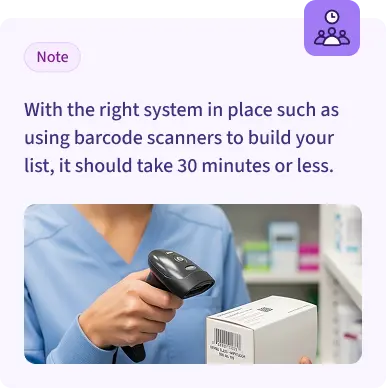
Regardless of who is placing regular supply orders, it’s always one task on what’s likely a very long list. If it takes more than one hour to order supplies regularly, there’s a process problem. That time adds up fast, especially when you start looking at multiple locations.
With the right system in place such as using barcode scanners to build your list, it should take 30 minutes or less. Granted, this may vary based on your practice size, but even heavy-producing practices shouldn't be spending more than an hour on ordering supplies.
Large fluctuations in monthly spend, ordering almost nothing one month, thousands of dollars the next, are a sign that there is no system guiding purchasing decisions.
Orders are happening in reaction to running out, not in response to a planned process.
Practices with consistent, usage-based ordering tend to keep supply spend at 5 to 6% of revenue collections. When spend swings month to month, that number creeps above 6.5% which is a numerical threshold where something in the process is clearly off. At that point, the underlying issues are almost always waste, rush orders, and over-purchasing catching up with the bottom line all at once.
A stocked supply closet with no organization is functionally the same as an empty one. If you asked someone right now if there is enough composite on the shelf or boxes of gloves are left, and the honest answer is "I'd have to go check," the inventory process needs attention.
Maintaining an accurate inventory list is the baseline for everything else, reordering, budgeting, waste reduction. Without it, purchases are made on guesswork.
This does not require a sophisticated system. An effective inventory tracking spreadsheet or a set of reorder cards that staff pull when stock gets low can be enough to get visibility. What does not work is relying on someone to remember.
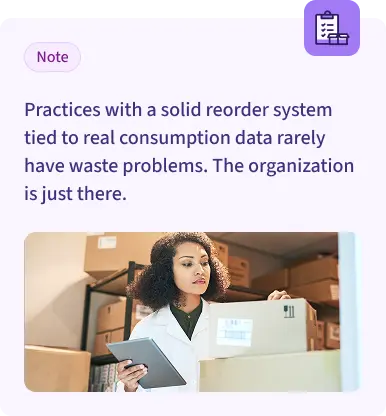
Every dollar of inventory that expires or gets discarded represents four dollars of production needed to cover it. A single $50 item that goes to waste means the practice had to generate $200 in revenue just to break even on that one line item.
Finding expired supplies at inventory time is almost always a symptom of over-ordering, no stock rotation, or buying in bulk for a promotional discount without accounting for actual usage.
Buy-three-get-one-free offers can be a legitimate 25% savings, or they can be six months of product sitting on a shelf depreciating. The right answer depends on your actual usage rate, and most practices are not tracking that.
Practices with a solid reorder system tied to real consumption data rarely have waste problems. The organization is just there.
Emergency supply orders, calling a rep to get something overnighted because a procedure is scheduled tomorrow, happen occasionally in any practice. When they become a regular occurrence, it means no one is monitoring stock levels proactively.
Rush orders carry two costs: the expediting fee itself, and the staff time spent scrambling. A basic reorder alert, whether in dental procurement software or through a simple threshold written on a sticky note in the supply closet, prevents most of these situations.
Without a system, no one sees the low stock level until it is already a problem.
In many practices, two or three people have purchasing access and place orders without visibility into what each other has done. This produces duplicate orders, overstocked shelves on some items and stockouts on others, and supply spend that no single person can fully account for.
A functional ordering process routes all requests through one system with a clear approval step. It does not have to be complex, it just needs to be consistent. When one person can see everything that has been ordered or is pending, most coordination problems resolve on their own.
For DSOs, this issue surfaces at the location level. Even within a larger organization, individual offices are dealing with the same coordination challenges as any independent practice. The DSO is not sending an inventory consultant to each location. Clear expectations in writing, what to order, how much, from whom, go a long way toward getting everyone on the same page.
Single-supplier relationships feel efficient. They are also how prices creep up quietly over time.
When a distributor knows there is no competition for your account, pricing pressure disappears. Little by little, prices drift up, not dramatically, but consistently. The practice stays focused on what it has always bought from who it has always bought it from, and no one checks whether that is still the best available price.
A competitive quoting process does not require switching suppliers. It means inviting two or three distributors to bid on the same product list, awarding each item to whoever came in lowest, and locking that pricing for three to six months. Then repeating.
Suppliers who know there is a fair process, that they have a real shot at winning business, will bring competitive pricing to keep the relationship active. Suppliers who know they have exclusive accounts stop competing.
The common thread across all seven signs is the same: no structure around what you buy, how much you use, and what things should cost.
Getting organized does not require a complete overhaul. A one to two week effort to document the process, set reorder points, build a preferred product list, and establish a simple approval workflow closes most of the gap.
From there, the three steps that capture the majority of available savings are:
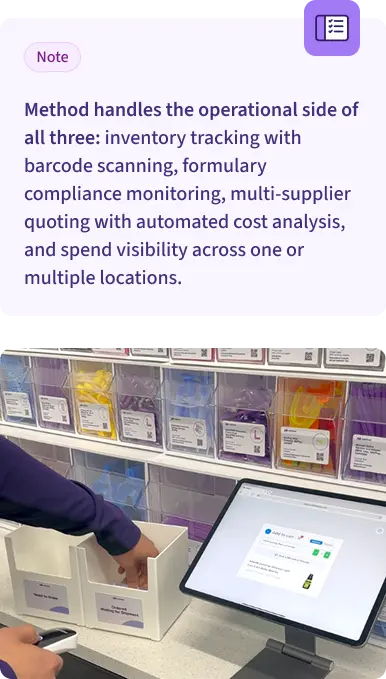
Method handles the operational side of all three: inventory tracking with barcode scanning, formulary compliance monitoring, multi-supplier quoting with automated cost analysis, and spend visibility across one or multiple locations.
If your practice is showing multiple signs from this list, the right move is to stop, think through what a real system looks like, and put one in place. The work is front-loaded. Once the process is running, it largely runs itself.